hoodie.

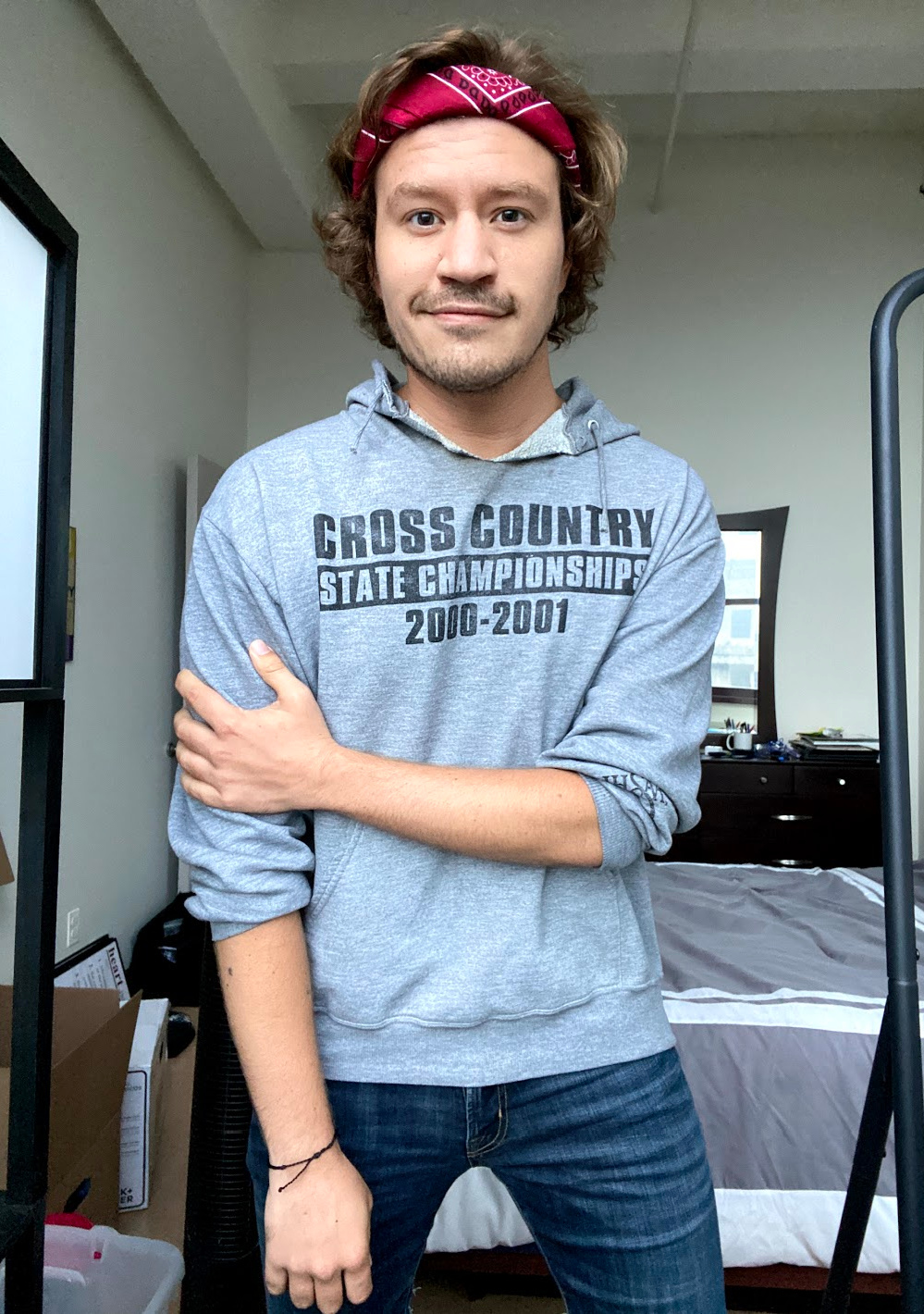
this hoodie has a history,
i wanted to tell him
as i dropped it in
his waiting palms

stolen from my sister
on the morning of the
Thanksgiving run,
some old boyfriend’s, but suddenly,
she must’ve known, mine

green stain from the
night my friends and i
tried painting my room,
my first lover and i
whispering i love you
at bedtime, smiling
in secret

grad school uniform,
late-night drinks and
later-night writing,
those wild, short months,
one last adolescence

given, for months, to somebody
who never intended to
stay, who slipped out of
my life like he owed
no explanation, but
who took the time to
fold it, hide it gently
on the closet floor
before he left,
found and held close
that fragile morning

for once, i
held onto my histories,
let a hoodie be, for the moment,
a hoodie, warm against
the artificial air

IMG_5483

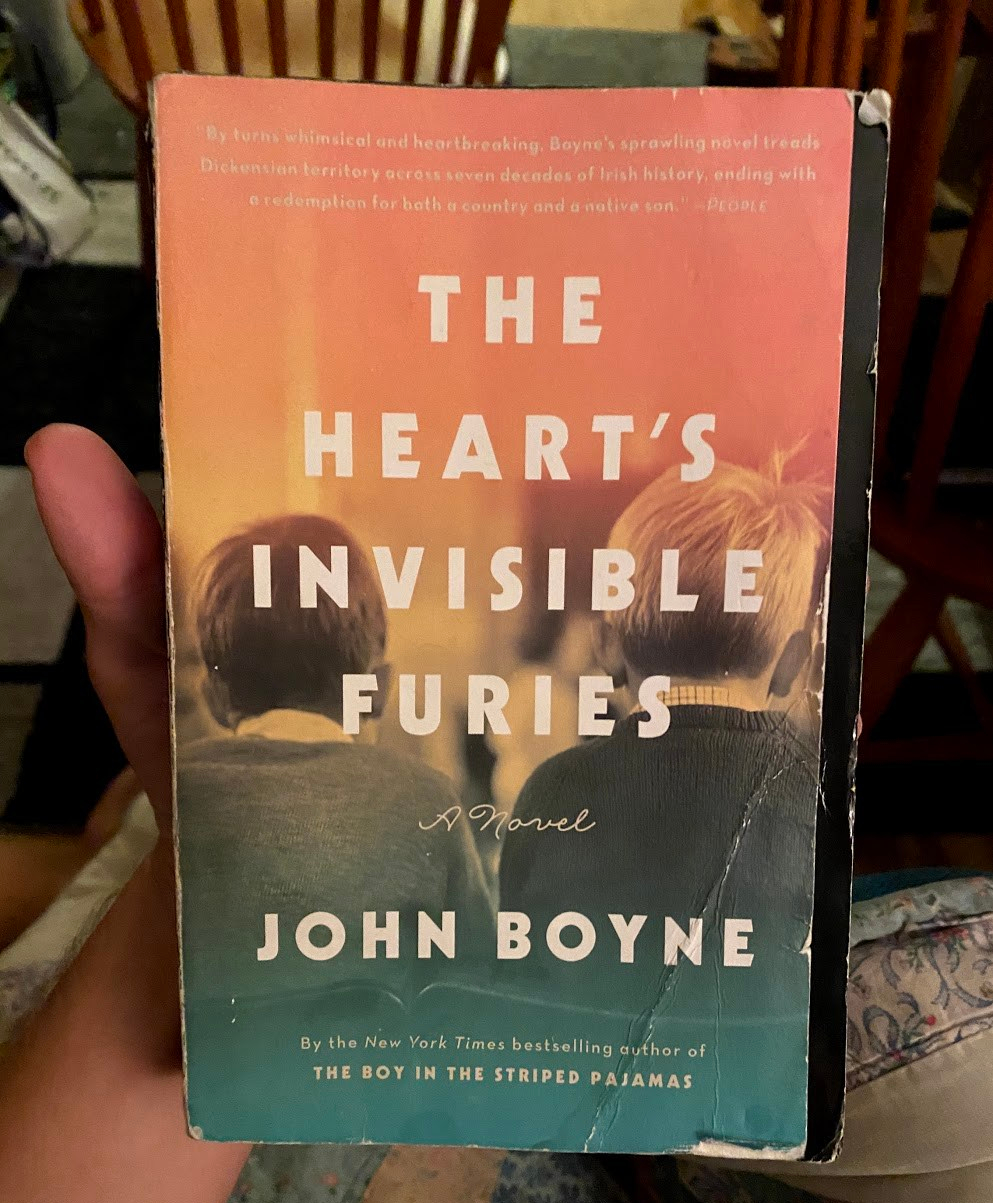
book club: ‘the heart’s invisible furies’.

“Want to read in the park?” my friend asked me, and my yes was emphatic. I rolled up my favorite blanket, tucked it away in my bag, and ordered a coffee for pickup on the way. About twenty blocks into my walk, it dawned on me: I’d left my book behind in my apartment. Sighing, I texted my friend, “I forgot my book. Got anything for me to read?”

As he descended down the steps of his apartment building in Hell’s Kitchen, his face had a wry grin. “Have you read this?” he asked, handing me The Heart’s Invisible Furies. I shook my head, and he smiled. “It’s so sad, but so funny, in this specifically Irish way. You are going to love it.”
IMG_5079

The Heart’s Invisible Furies opens in a church building in a small village in Ireland. There, a teenaged girl is being publicly rebuked for her pregnancy, after which she arrives home to find her belongings outside the front door. Head held high, shaking her head at the unfairness of her world, she boards a bus to Dublin, where a chance encounter with a stranger changes everything.

“Long before we discovered that he had fathered two children by two different women, one in Drimoleague and one in Clonakilty, Father James Monroe stood on the altar of the Church of Our Lady, Star of the Sea, in the parish of Goleen, West Cork, and denounced my mother as a whore.”

The narrator in The Heart’s Invisible Furies is Cyril Avery, the child produced from the text’s early pages. His story is shared in chapters, each taking places seven years following the prior chapter. As the first chapter ends, Cyril’s mother in labor and bringing him into the world, the second chapter picks up, and we meet Cyril’s adoptive parents. There’s a jarring effect to this; at the beginning of each chapter, I found myself wondering what became of some of the characters I’d just fallen in love with.

As Cyril’s story moves forward, however, old characters weave themselves back in the narrative in surprising ways. As he discovers himself, a child adopted by wealthy, if unconventional, parents, he grapples with the journey of being ill-fit for the rigid world around him.

“It was a difficult time to be Irish, a difficult time to be twenty-one years of age and a difficult time to be a man who was attracted to other men. To be all three simultaneously required a level of subterfuge and guile that felt contrary to my nature.”

At its core, The Heart’s Invisible Furies is an examination of a life –– the way in which people appear, strangers at first and then vital sources of joy and pain, and are lost to us. In this story, there is violence, grief, failure, abandonment, an also there is humor, longing, love, and beginning anew. Humanity is under the narrator’s microscope, always explored with a bit of comical irreverence.

“But for all that we had, for all the luxury to which we were accustomed, we were both denied love, and this deficiency would be scorched into our futures lives like an ill-considered tattoo inscribed on the buttocks after a drunken night out, leading each of us inevitably toward isolation and disaster.”

After I posted a picture of the park on a night reading, I heard from several people who’d read this text before me. They each acknowledged that they’d loved it, and I trusted it would stick with me long after I finished it. The Heart’s Invisible Furies offers a gentle window unto all of us, our humanity, our cruelty toward the people we deem outsiders, our cruelty toward the people we are trying to love, and the ways in which we keep going after enduring grief. Told over seventy years, Cyril’s story features so much beginning again, and again, and again.
stubborn color.

remember the time
i told you everything
at that pizza hut,
the way the waitress
saw us crying and
kept checking to
make sure the
food was all right?

seems so silly, today,
how big everything
seemed, the worry
that, if i told you,
something might
change color, and
we’d never get the
picture right again

you looked at me,
then, and told me
nothing inside you
scares me, and
the waitress brought
two more cups of soda
to stop our tears

well, just know, today,
every atom of you is
home to me, all the
color is set all the way down,
and nothing,
nothing, nothing
inside you scares me

Hand

up in smoke.

all the anger
gave way to
something much
softer, as it
goes, even the
hottest of fires
eventually tires
itself out

sifting through the
ash, my palms
discovered that
the best of you
survived, memory a
salient scrape

and i thought of
telling you, calling you
up to say the love
outlasted the anguish, 

but i let the
intention loose

we are not those
boys anymore,
building and
breaking apart in
coffee shops, they are
long since gone

September15_1

what ifs.

what if i told you
your name is
the missing word
on a hundred
crumpled-up love letters
in the corner of
my living room

what if i read you
a list of the small things
you do
that birth quiet tidal waves
against my sternum

what if i shared the
story, up to now,
filling in the spaces
i left empty so as
not to ask for
too much

what if i promised
i want nothing in return,
no need for even a
response, i just need
these feelings to
know honest air

what if those
promises were just
new lies, new
ways of painting
myself safe

what if everything
crumbled, my palms
acquainting again
with the roughly paved
road of being the one
who loved somebody
more

what if i kept
holding my breath, just
for now, while my
mind argues with
my heart, pointing at
the past, gesticulating
wildly, we have
tread these rocks
before

what if you’re
waiting, aware in
some quiet way,
flowers already bunched
in your shaking palms

Three Houses

i want to say.

i want to say,
in the hard and harrowing
days, i wrote my finest
poetry, found words
for the wordless nights, kept
hope in the loneliest echo

i wish i didn’t cry
on the nights i drink with
you, but at least
i can say i am crying
because i can’t believe
you’d join me here
on the concrete

and i want to say
thank you, to
everybody, our eyes
meeting so you
feel my sincerity, i
have kept every
story of you
from the years
already yellowing
on windowsills, i
remember all your
youngest days.

poetry

epitaph.

on the windowsill, collecting
dust, a clay planter’s pot,
on whose sides
were carved
the hardest epitaph:

i kept this plant alive
for months and
months, seasons
of uncertain air, with only
my own water, imagine
what might blossom
when he pours
into it, too.

Three Houses

three weeks into june.

Three weeks into June, and I’ve grown accustomed to pulling a mask over my face before walking out under the sun. At 25, hands shaking, I promised myself, if I could just say the truth out loud, I would never have to wear a mask again. It feels the same and different, hard to breathe but no smile at my disposal to reassure everybody else.

Three weeks into June, and I hear your life updates from a friend you still talk to. It’s been years, I tell myself, but some wounds sting long after they’ve healed. You are the ankle I sprained seven summers ago, still tender when the weather changes. Have no fear, I am well-practiced in the art of writing you letters you will never read. I whisper well wishes into the cardboard boxes you’ve still yet to unpack.

Three weeks into June, and I don’t know what to do with my reflection in the mirror. Has my body changed, has my face grown weary? In my first week of solitude, I broke down in tears remembering no one I love had seen me in days. Lately, the second I find myself surrounded in company, something in me yearns to be alone. I think I’m afraid to get used to the sound of familiar voices.

Three weeks into June, and I am trying with every atom to show up, and I am tired down to every hollow breath. Sometimes I count every footstep on a four-mile run. Sometimes I run longer, just so I can stay outside and forget how different the world was a year ago. Living the same story each day is a wave crashing against the rock wall of trying to muster the energy to write something else.

Three weeks into June, and hope arrives in a hundred forms. The sun rolls itself across green park grasses. My niece sends a Snapchat in the Pride filter. I hear the sound of a friend’s laugh over the phone and forget he’s not right here. I meet a man on rollerblades as I nurse a margarita on the sidewalks of Hell’s Kitchen. I notice people are hugging each other again, hesitation giving way.

Three weeks into June, and I miss making plans. I wonder at my audacity, just a few months ago, booking flights to London and building itineraries. I have hit backspace so much in 2020 that I sometimes forget it is not 2017.

Three weeks into June, and I’m here, hoping and building, tired and trying, fighting like mad to push love through every layer of concrete between us.

Screen Shot 2020-06-21 at 8.52.34 PM

book club: ‘hunger’.

The moment I heard Roxane Gay talk about her forthcoming novel Hunger, I made a mental note that I would, of course, read it. The summer before, I’d ravenously read Bad Feminist, her collection of essays, and I wanted to bask in her writing a bit more. Beyond that, however, I was mesmerized by her description of what it would contain: “it’s a memoir of the body,” she said in an interview with Trevor Noah, “my body.”

Roxane Gay is a woman with a large body, and – in discussing Hunger – her voice seemed uncharacteristically reserved, tenuous, gentle. She acknowledged her story involves hunger in a number of ways, and her memoir would explore that.

Anybody who’s ever struggled to live in their body, to love it as it is in a world pushing them to shrink it, will find resonant notes in Hunger. What a thing it is to crave, to try and starve the wrong hungers and feed the correct ones. Fearlessly, or perhaps despite the fear, Roxane Gay explores her own relationship with hunger.

103613845_922968908146005_6058145923983544773_n

Hunger is a memoir arranged in a series of numbered explorations. Some of them are brief –– a musing about sex in a fat body, a description of foods not allowed in her childhood home –– while others stretch on for a few pages. Many elements of the story are deeply personal to Roxane’s story herself –– her childhood, her family, her traumas, her romances –– but there are also passages dedicated to analyzing facets of our society we have accepted as normal. The Biggest Loser, she makes a case, is one of the most harmful shows ever to be on television. (And, she adds, she was mesmerized by it.)

“This is the reality of living in my body: I am trapped in a cage. The frustrating thing about cages is that you’re trapped but you can see exactly what you want. You can reach out from the cage, but only so far.”

In Hunger, Roxane primarily tells the story of her body in a chronological fashion. She describes her body in her youngest days, its youthfulness and momentum, and acknowledges that it is a body she does not remember. The narrative does jump around a bit, and she does revisit ideas with further rumination as she shares her story. Her view of love, of her right to connection and passion and sex and desire as a fat person, evolves and devolves. There is a push and pull to healing, to accepting the bodies we inhabit, and the structure of Hunger embodies that.

“Because I read so much, I was a romantic in my heart of hearts, but my desire to be part of a romantic story was a very intellectual, detached one. I liked the idea of a boy asking me out, taking me on a date, kissing me, but I did not want to actually be alone with a boy, because a boy could hurt me.”

I was, at times, startled by the vulnerability with with Roxane Gay chose to share details of her life in Hunger. To share her exact weight –– a number she acknowledges is startling –– feels a bit revolutionary, as society often chides us never to ask. This is a guise, she points out –– society has never granted fat people their privacy, their right to inhabit their bodies. She describes instances of unsolicited judgment from strangers, from friends, from family, all obsessed with the ‘problem’ of her body.

This, of course, has placed obstacles between Roxane and her hunger for connection, for romance, for wholeness. Society has continuously pushed her to see her body as a problem, a list of limitations, and she shares no small list of indignities she has had to face as a fat woman. Desk chairs, stages without stairs, booths without the ability to adjust, airplane seats –– all of these rigidly, on occasion, refusing to make room for her to belong.

“Everyone was so worried about me when I broke my ankle and it confused me. I have a huge, loving family and a solid circle of friends, but these things were something of an abstraction, something to take for granted, and then all of a sudden, they weren’t… There were lots of concerned texts and emails, and I had to face something I’ve long pretended wasn’t true, for reasons I don’t fully understand. If i died, I would leave people behind who would struggle with my loss. I finally recognized that I matter to the people in my life and that I have a responsibility to matter to myself and take care of myself so they don’t have to lose me before my time, so I can have more time. When I broke my ankle, love was no longer an abstraction. It became this real, frustrating, messy, necessary thing, and I had a lot of it in my life. It was an overwhelming thing to realize. I am still trying to make sense of it all even though it has always been there.”

There’s a truth in Hunger that will resonate deeply within just about anyone: We all have an ongoing relationship with our bodies, we all have been conditioned to recognize some of our hungers as unearned, and we all know what it is to yearn for freedom from our obstacles. There’s a universality to this message, to the vulnerability of Roxane’s story, to the ongoing (and forever-going) journey of feeling at home where we are.

But, more importantly, there’s a story being told, a story often untold (or, at least, unheard): the story of a person, in a fat body, trying to navigate the world around them and to believe they are worthy of the love and the life they yearn for. That, I think, is where this story will echo with me for the longest.